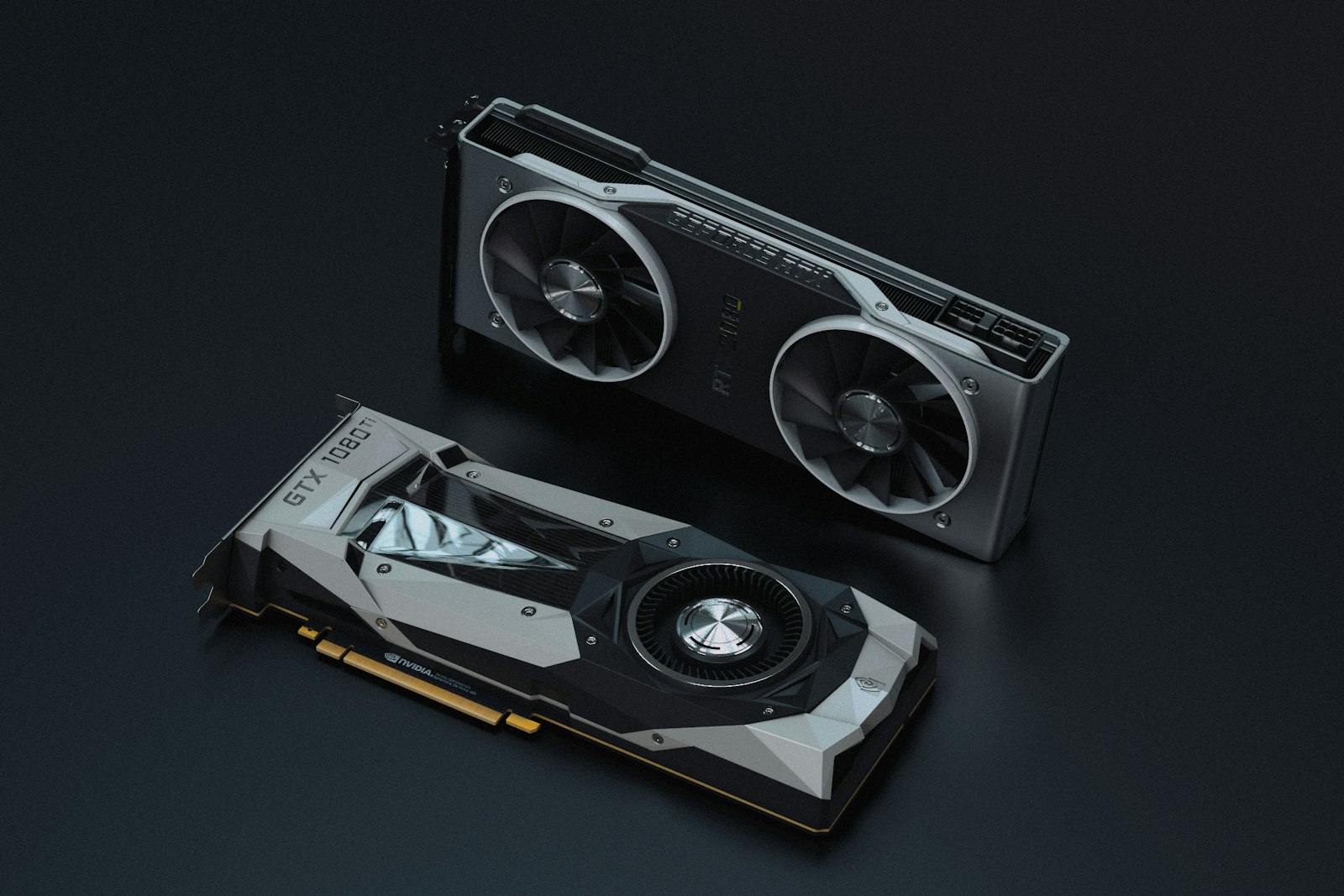
Quick Verdict
The RTX 5090 is faster — by a lot, especially in ray-traced workloads and any task that touches CUDA. The RX 9070 XT is a third of the price. If you have $2,000 to spend on a graphics card and you do creative work that touches CUDA, OptiX, or DLSS, the 5090 makes sense. For everyone else — including most enthusiast gamers — the 9070 XT is the better value upgrade in 2026.
The Spec Sheet
| Spec | RTX 5090 | RX 9070 XT |
|---|---|---|
| Architecture | Blackwell | RDNA 4 |
| Shader Cores | 21,760 | 3,584 |
| RT Cores | 170 (4th gen) | 56 (3rd gen) |
| VRAM | 32GB GDDR7 | 16GB GDDR6 |
| Memory Bus | 512-bit | 256-bit |
| Bandwidth | 1,792 GB/s | 624 GB/s |
| Boost Clock | 2,407 MHz | 2,970 MHz |
| TDP | 575W | 304W |
| Power Connector | 16-pin (12V-2×6) | 2× 8-pin |
| Launch Price | $1,999 | $599 |
Raw Gaming Performance (1440p, Ultra)
| Game | RTX 5090 | RX 9070 XT | 5090 Advantage |
|---|---|---|---|
| Cyberpunk 2077 (RT off) | 196 | 132 | +48% |
| Cyberpunk 2077 (RT Overdrive) | 118 | 54 | +118% |
| Alan Wake 2 (Path Tracing) | 92 | 38 | +142% |
| Counter-Strike 2 | 612 | 548 | +12% |
| Black Myth: Wukong | 168 | 112 | +50% |
| Helldivers 2 | 184 | 148 | +24% |
| Hogwarts Legacy | 192 | 134 | +43% |
| Spider-Man 2 | 178 | 122 | +46% |
4K Gaming
The RTX 5090 averaged 132 fps at 4K Ultra across our 20-game suite. The RX 9070 XT managed 84 fps. At 4K, the 5090 is a genuine no-compromise card. The 9070 XT is a “4K-capable” card — you’ll be turning some settings down or using FSR upscaling for the most demanding titles.
Creative Workloads
This is where the gap explodes. The CUDA ecosystem still dominates creative software in 2026.
| Workload | RTX 5090 | RX 9070 XT |
|---|---|---|
| Blender BMW (OptiX) | 8.2s | 34.1s (HIP) |
| DaVinci Resolve 8K timeline | 52 fps | 23 fps |
| Topaz Video AI 4K upscale | 1.3x realtime | 0.4x realtime |
| Stable Diffusion XL (img/min) | 14.2 | 5.1 |
| Llama 3.3 70B inference (tok/s) | 42 | 11 |
Power and Thermals
The 5090 is a beast. 575W TDP means you need a 1000W+ PSU and you’ll need to manage case airflow seriously. Under sustained load it pulls a real-world 540W and exhausts hot air aggressively. The 9070 XT is comparatively gentle — 304W TDP, runs on most existing 750W systems without an upgrade.
Upgrade Cost Math
The RTX 5090 doesn’t just cost $2,000. To actually use it you may need:
- 1000W+ PSU (~$180)
- New case with better airflow (~$150)
- Faster CPU to avoid bottlenecks at 1440p (~$300-500)
- Adequate ventilation room around the GPU
Realistic total upgrade cost: $2,500-3,000.
The RX 9070 XT at $599 fits in most existing builds. If your current PSU is 750W+, your case has reasonable airflow, and you don’t have a particularly old CPU, you can drop the 9070 XT in and be done.
RTX 5090 Pros
- Best gaming performance, period
- 32GB VRAM future-proofs creative work
- OptiX for Blender, CUDA for everything else
- DLSS 4 with Multi Frame Generation
- Local AI workloads run brilliantly
RTX 5090 Cons
- $1,999 + $500-1000 in support upgrades
- 575W TDP demands strong cooling
- 12V-2×6 connector still has user error risk
- Three-slot card limits case compatibility
- Limited stock at MSRP
Who Should Buy What
- Buy the RTX 5090 if: you do 3D rendering, AI/ML work, video editing, or local LLM inference — those use cases pay for the card. Or if you have unlimited budget and want the fastest possible gaming experience.
- Buy the RX 9070 XT if: you primarily game at 1080p or 1440p, you don’t do CUDA-locked creative work, and you want excellent value. Pair it with FSR 4 for a great experience.
- Wait if: you’re between these — the RTX 5080 (16GB) at $999 might be the sweet spot if you can find it at MSRP.
Bottom Line
The RTX 5090 is technically the better card by every metric. The RX 9070 XT is the better card for most people’s actual budgets and workflows. Match the card to your use case, not to benchmarks of workloads you’ll never run.
Frequently Asked Questions
Which is better for gaming?
Is it worth upgrading from the previous generation?
Which has better power efficiency?
What about long-term value and resale?
You Might Also Like
AMD FSR 4 vs NVIDIA DLSS 4: Which Upscaler Looks Better in 2026?
Both upscalers got major upgrades in 2026. We tested both side-by-side across 12 games to see which one actual…
M.2 NVMe vs SATA SSD: Does the Speed Difference Actually Matter?
On paper, NVMe SSDs are 7x faster than SATA. In real-world use, the gap is much smaller — and sometimes invisi…
Intel Core Ultra 9 285K vs AMD Ryzen 9 9950X: Which Flagship Wins in 2026?
Two flagship desktop CPUs, two very different architectures. We ran 24 games, 18 productivity benchmarks, and …

Best Graphics Cards of 2026: From $300 1080p to $2,000 Halo Builds
We benchmarked 21 graphics cards across 28 games at 1080p, 1440p and 4K. Here’s the honest, tier-by-tier…